Tire Disposal in Santee, CA: Why You Can't Just Throw Old Tires in the Trash
Tire Disposal in Santee, CA: Why You Can't Just Throw Old Tires in the Trash
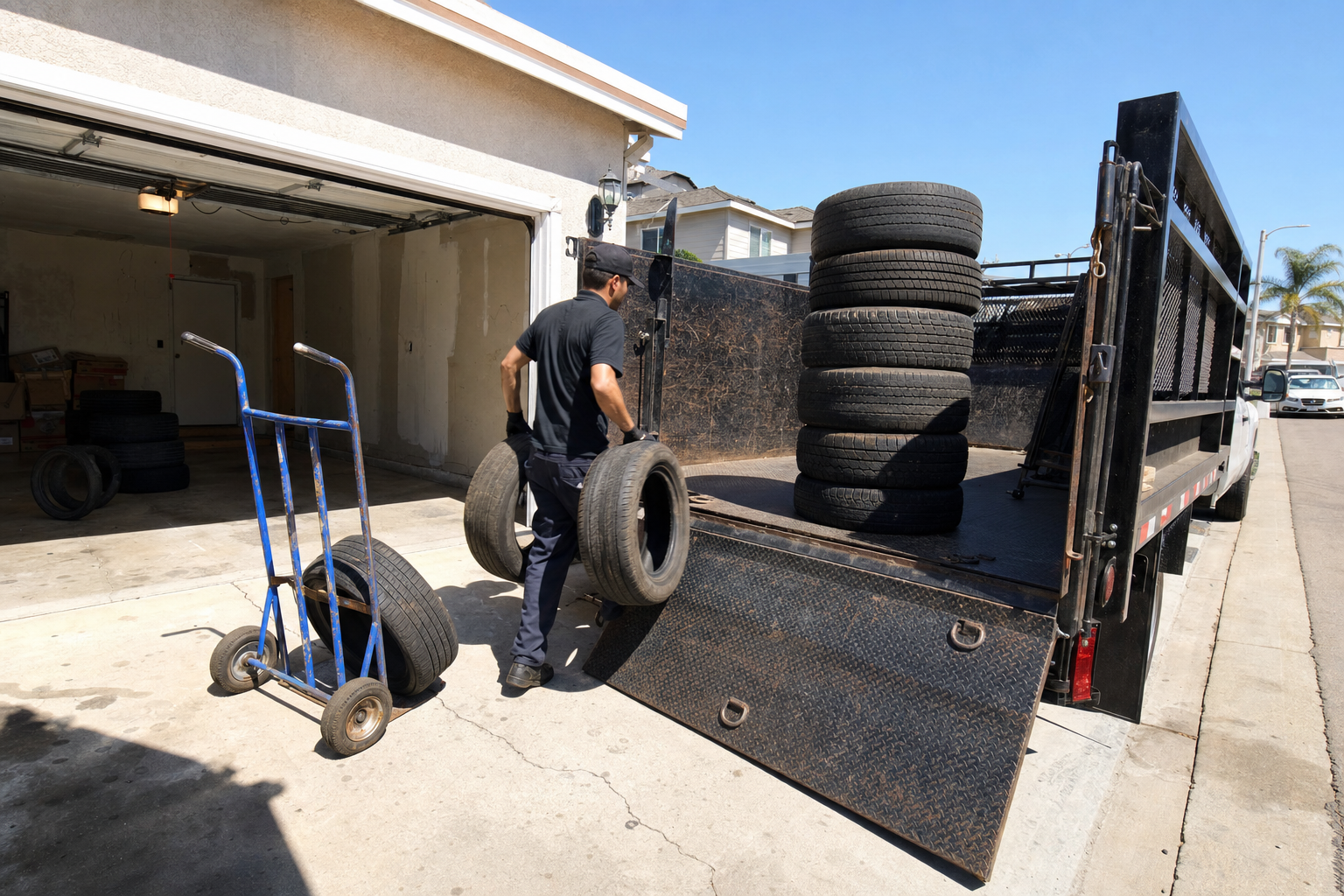
Quick answer: California bans whole tires from landfills statewide — they have to be shredded or quartered before they can legally be landfilled, which is exactly why your regular trash hauler, the city's bulky item pickup, and most transfer stations will all turn away a loose tire. Individuals can legally transport up to 9 waste tires at a time without special registration; anything beyond that requires a CalRecycle waste tire hauler registration and manifest tracking.
Why Can't You Just Put Old Tires in the Trash or at the Curb?
Under CalRecycle's waste tire program, California treats tires as a regulated material, not ordinary household trash. Whole tires trap air and don't compact the way other waste does, and they're banned from direct landfill disposal statewide unless they've already been shredded or quartered first. This is exactly why tires don't qualify for Santee's free bulky item pickup program the way a couch or mattress does — the hauling and processing requirements are simply different.
What's the 9-Tire Rule, and What Can You Legally Haul Yourself?
If you're dealing with a handful of old tires — say, from a set change or a small cleanout — California law allows individuals to transport up to 9 waste tires at a time in their own vehicle without any special registration or paperwork. The moment you're moving 10 or more tires at once, state law requires the vehicle to be registered as a waste tire hauler with CalRecycle, with the load tracked through a formal manifest and trip log. This threshold matters if you're clearing out a garage, a rental property, or a property that came with a stockpile of old tires left behind by a previous owner.
Why Are Tire Fires Such a Serious Concern?
This isn't a bureaucratic technicality — California's tire laws exist because of real disasters. After a series of long-burning, difficult-to-extinguish tire fires in the late 1990s, the state strengthened its original 1989 Tire Recycling Act with additional storage and hauling safety rules in 2000. Improperly stored tire piles are also a well-documented breeding ground for mosquitoes and rodents, which is part of why the state treats large-scale improper tire storage and dumping as a genuine public health and safety issue, not just a landfill-space problem.
What Happens If You Illegally Dump Tires in Santee?
The consequences here are real and, in some cases, severe. Hauling waste tires to an unpermitted disposal site can carry fines up to $10,000 and potential jail time, and operating as an unregistered waste tire hauler for loads of 10 or more can bring fines up to $25,000. This is on top of California's general illegal dumping penalties under Penal Code 374.3 — and fines specifically double when the dumped material includes tires, which we cover in our bulky item pickup guide. CalRecycle has pursued real enforcement action over this: in 2022 alone, the agency secured $1.2 million in penalties against three California tire businesses for repeated waste tire storage and hauling violations.
Where Can Tires Actually Go?
The tire shop that sold you your new set will typically accept your old tires for a small per-tire fee, often bundled into the installation cost — usually the simplest route if you're just swapping a standard set of four. Beyond that, county-certified transfer and recycling facilities throughout the San Diego area accept waste tires for a modest per-tire drop-off charge, with higher fees for larger truck or off-road tires still mounted on rims.
Got Multiple Tires From a Cleanout or Garage Purge?
If you're clearing out a garage, an estate, or a rental property and find yourself with more tires than the 9-tire self-haul limit allows, a professional hauler already registered and equipped for proper tire disposal handles this without you needing to navigate the manifest and registration requirements yourself. This is exactly the kind of situation our garage cleanout service is built to handle alongside whatever else needs to go.
What Does Proper Tire Disposal Cost in Santee?
Cost depends on tire count and type — passenger tires cost less to process than larger truck or off-road tires, and tires still mounted on rims typically cost more than loose tires. We provide a free quote before any work starts so you know exactly what to expect.
FAQ
Can I put old tires out with my regular trash in Santee?
No. California bans whole tires from landfills statewide, and standard trash haulers and bulky item pickup programs won't accept them.
How many tires can I legally transport myself in California?
Up to 9 waste tires at a time without special registration. Moving 10 or more requires the vehicle to be registered as a waste tire hauler with CalRecycle.
What happens if I illegally dump tires in Santee?
Penalties can include fines up to $10,000 for dumping at an unpermitted site, up to $25,000 for unregistered hauling of 10 or more tires, and illegal dumping fines under Penal Code 374.3 double when tires are involved.
Why are old tires considered a fire hazard?
Improperly stored tire piles have caused long-burning, difficult-to-extinguish fires historically, which led California to strengthen its tire storage and hauling safety laws after incidents in the late 1990s.
Where can I take old tires in the Santee area?
Tire shops that sell new tires typically accept old ones for a small fee, and county-certified transfer and recycling facilities throughout San Diego County accept waste tires for a per-tire drop-off charge.
Have a stack of old tires or a garage full of them to clear out?
Free quotes: (619) 792-1285.